ºÚÁÏÌìÌà (ANU) Research School of Physics has celebrated 79 years of research, teaching and discovery, bringing its community together to reflect on the School’s history and recognise the people shaping the future of physical sciences.
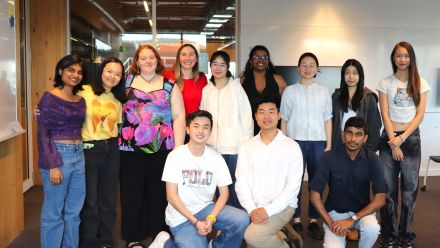
Staff and students gathered on Friday 23 October for Founders’ Day, the School’s annual flagship event honouring the vision of its founder, Sir Mark Oliphant, and celebrating the breadth of work taking place across physics at ANU.
School Director Professor Jodie Bradby opened the event by reflecting on the School’s history, from its establishment in 1947 as one of the University’s first schools and laboratories to the commissioning of its nuclear particle accelerator in 1973.
With 2026 marking 125 years since the birth of Sir Mark Oliphant, Professor Bradby highlighted how the School’s history continues to shape its future, including through the refurbished Oliphant Building, which was named in his honour many years ago, and the facilities in the School’s new building, such as the state-of-the-art cleanroom and stable labs.
“We have these amazing facilities, for meeting and convening conversations, for doing research, and so much more than that. With the Oliphant Building now physically connected to the new building, this represents the interconnection between the new and the old," she said.
The School’s achievements extend well beyond its world-class facilities. Its community includes current staff and students, visiting researchers from around the world, more than 30 active industry and government partners, and eight spin-out companies.
"We've always been proud of our outstanding physics education, fostering a love of learning and science throughout our programs," said Professor Bradby.
The School is home to four national facilities open to researchers across Australia, including the country’s only nuclear particle accelerator, supporting research that extends well beyond the University.
"We have people from all over Australia, and indeed the world, come and do experiments with us. This is not just a facility for us, but for Australia, and that's really important as the national university," said Professor Bradby.
This year’s Founders’ Day program showcased the breadth of research across the School, with public science talks exploring nonlinear optics in atomically thin semiconductors, how light interacts in a vacuum, moths in space, the future of low-emission materials, and identifying imposters across the transient realm.
Award presentations recognised achievements in student research, technical expertise, research translation and partnerships. A new award for 2026, the Brian Robson Award, was introduced to support honours and postgraduate students, or early career researchers, working in theoretical physics.
ºÚÁÏÌìÌÃChancellor Dr Gordon de Brouwer AO joined the celebrations, recognising the School's extraordinary research, teaching and community. He also hosted an informal question and answer session, exploring the contribution of physics research and teaching, connections with specialist capabilities across the public sector, and the role of university governance in supporting academic work.
The day also marked a milestone in the School’s physical development, with Dr de Brouwer and Professor Bradby officially opening a new corridor connecting the New Physics Building with the refurbished Oliphant Building. The connection completes a project years in the making.
“This link represents the culmination of a decade of work by countless staff. It was a lovely moment to see the Chancellor cut our ribbon and the School walk down that corridor together for the first time," said Professor Bradby.
The celebrations continued over lunch, with lawn games, trivia, a gelato van, and opportunities for staff, students, alumni, and partners to connect.
For Professor Bradby, the flagship event is a valuable opportunity for the School community to come together beyond their day-to-day work.
“One of the really important things about Founders’ Day is the time to pause and reflect, relax, socialise with colleagues, and spend some time together.�
"We are number one for physics in Australia, and we're very proud of that. I truly believe physics at ºÚÁÏÌìÌÃhas a bright future, built on our current staff and facilities with our deep history as our foundation.â€�